Disclosure: This article contains affiliate links. If you buy through them, we may earn a commission at no extra cost to you.
Apollo’s Basic plan costs $49 per seat per month, billed annually. LeadOcean‘s lifetime deal on AppSumo costs $49, once. It is the same number on the price tag, and a very different deal.
But price alone doesn’t settle it. Apollo is a full sales platform: data, email sequences, a dialer and a Chrome extension in one seat. LeadOcean is only the data, with no credits to buy. So the real question is whether a credit-free data tool is enough for you, or whether you need an all-in-one platform.
To answer it, we compare LeadOcean with Apollo, ZoomInfo and Lusha on 12 jobs you actually do when you prospect, from building a list to calling a lead. Then we add up what each option costs over one and three years, and give a clear buy-or-skip answer for each type of buyer.
If you want a feature-by-feature tour of LeadOcean first, read our full LeadOcean review.
Quick answer
- Buy the LeadOcean deal if you mainly need data in bulk: lists, enrichment, emails and phone numbers.
- Stay on Apollo if you want data, sequences, a dialer and a Chrome extension in one seat.
- Choose ZoomInfo if you are an enterprise team that needs intent data and org charts, and you can sign an annual contract.
- Choose Lusha if you only do light, occasional lookups from a browser extension.
Who should buy the LeadOcean lifetime deal?
The deal makes the most sense for people whose biggest cost today is data credits.
- Lead generation agencies building lists for clients. LeadOcean’s monthly Agency plan explicitly allows client work. If you plan to use the lifetime deal for client lists, check the licence terms on the deal page or ask LeadOcean first.
- Solo founders and small sales teams doing outbound on a tight budget.
- Clay, n8n and Make power users who pay for every enrichment today.
- Builders of AI SDRs and agents that need live B2B data through MCP or an API.
Skip it if you need sequences or a dialer in the same tool, buyer intent data, or a Chrome extension for LinkedIn. LeadOcean offers none of those.
The LeadOcean AppSumo deal at a glance
You pay once and keep access for life. Every one of the five tiers includes people search, company search, verified work emails, phone reveals and the MCP server for AI tools.
Tier | One-time price | Search records | Enrichments | Phone reveals | Team seats |
|---|---|---|---|---|---|
1 | $49 | 100K a week | 10K a week | 100 a month | None |
2 | $199 | 250K a week | 25K a week | 500 a month | None |
3 | $399 | 500K a week | 50K a week | 1,500 a month | None |
4 | $999 | 750K a week | 100K a week | 5,000 a month | None |
5 | $1,999 | 25M a month | 1M a day | 15,000 a month | 5 |
The weekly figures for Tiers 1 to 4 also come in 5-hour slices. Tier 1, for example, allows 20,000 search records and 2,000 enrichments every 5 hours, up to the weekly maximum. Tier 5 has no weekly cap at all.
Here is the important part in plain words: these limits are a speed, not a balance. They refill on their own. You never run out and have to buy more, and you are never charged extra. One record is one person or company returned, so a page of 25 people counts as 25.
The deal terms on AppSumo:
- 60-day money-back guarantee.
- Activate your licence within 60 days of purchase.
- All future plan updates included.
- Move up or down between the five tiers.
- No codes and no stacking.
For context, the deal has a 4.87 out of 5 rating from 322 reviews on AppSumo at the time of writing.
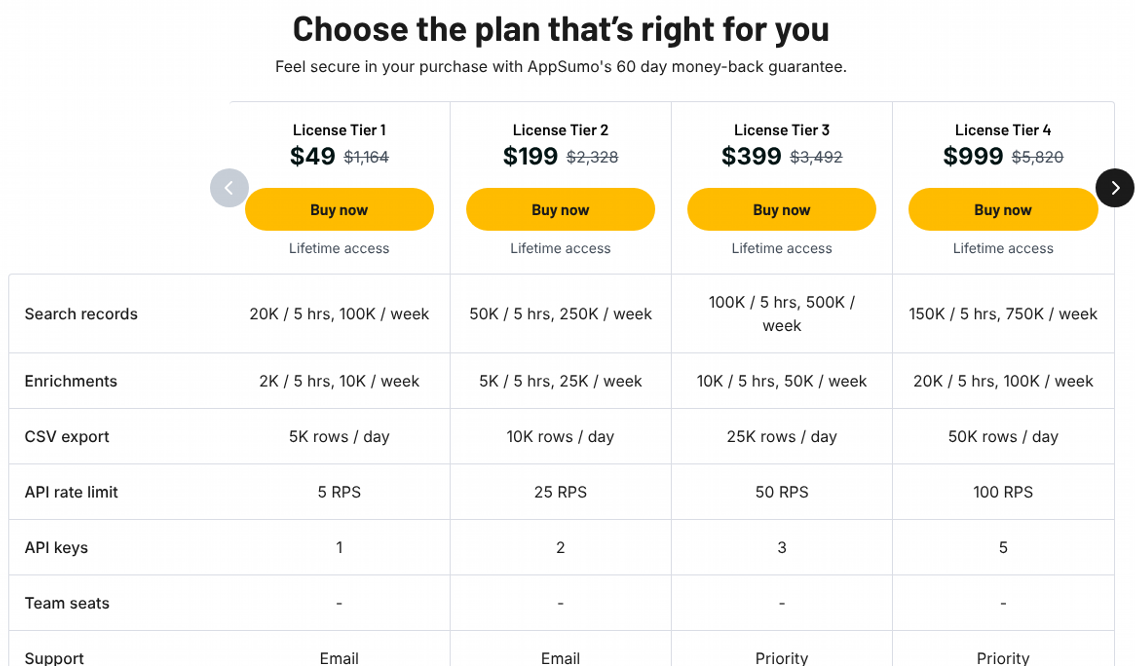
AppSumo tiers 1 to 4. Source: AppSumo LeadOcean deal page, 17 Nov 2026.
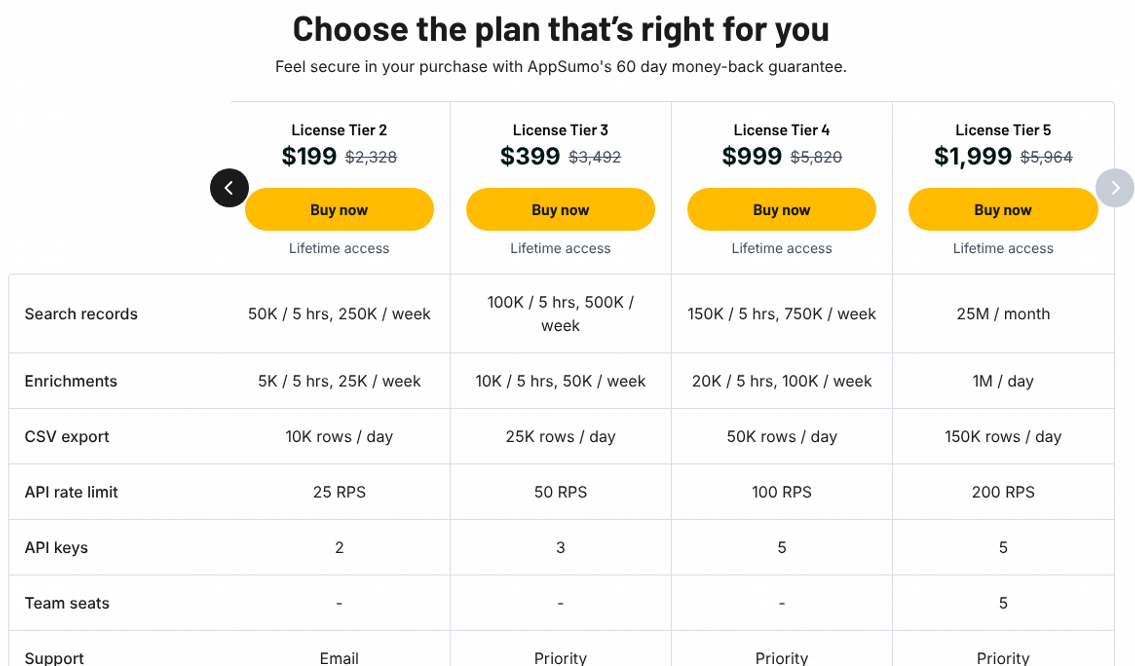
The same table moved one column to show Tier 5. Source: AppSumo LeadOcean deal page, 17 Nov 2026.
1. Build a prospect list from your ICP
Every tool here can build a list from filters. The difference is what the filters cost you and how many you get.
- LeadOcean: 50+ people filters, including job title, seniority, job function, industry, headcount, funding, technologies and location. Results count as records against your pace, never as credits.
- Apollo: advanced filters on paid plans, basic filters on the Free plan.
- Lusha: filter-based search, with basic and advanced filters on its Free plan.
- ZoomInfo: filter-based search, inside an annual contract.
We ran the same search in LeadOcean and Apollo on 17 November 2026: VP or Head of Sales, in the United States, at software companies with 51 to 200 employees. Both tools were connected the same way, through their own MCP servers inside Claude.
LeadOcean found 2,718 matching people. 1,380 of them had a verified or catch-all email, and 2,196 had a phone number. Apollo’s Free plan answered “plan does not include” to both people search and enrichment over its MCP connection, so it returned no numbers to set beside LeadOcean’s. Apollo’s web app does offer basic search on the Free plan, but for automated or AI-driven prospecting, the Free plan was a dead end in our test.
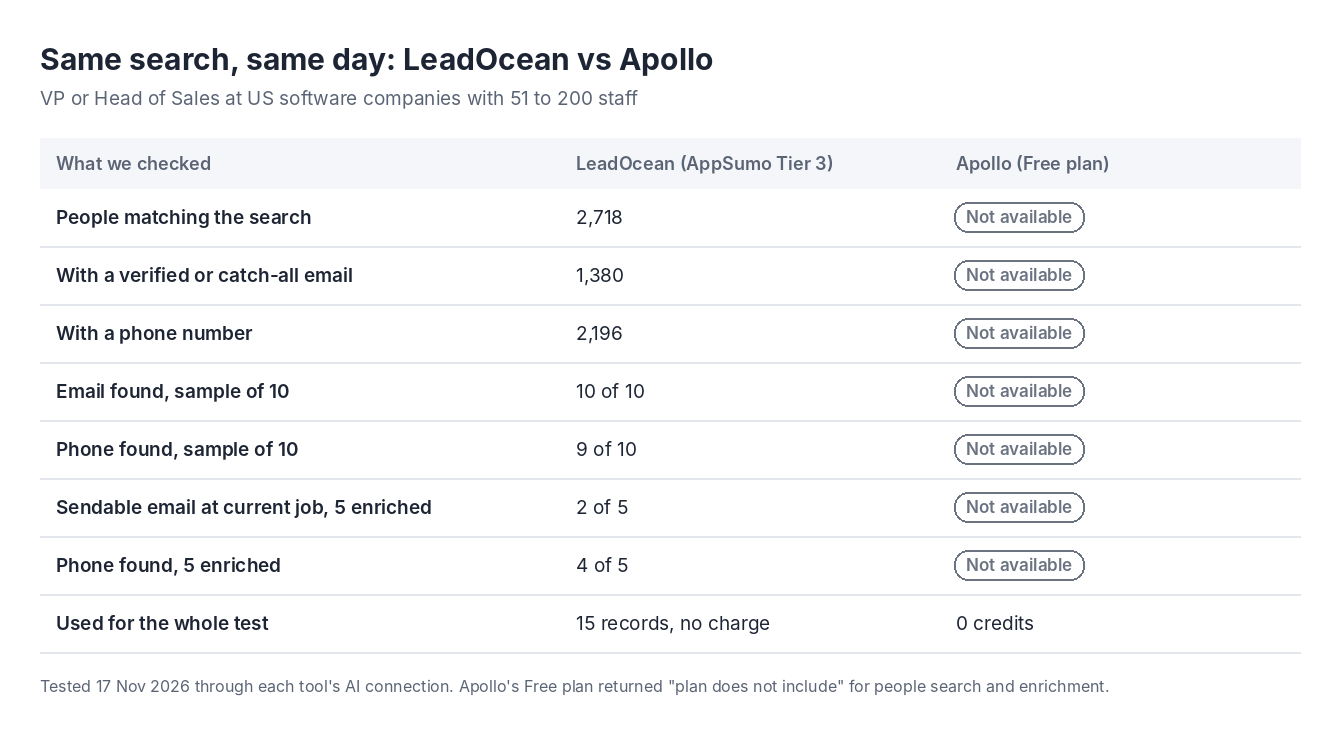
Same search, same day: our LeadOcean vs Apollo test, 17 Nov 2026.
2. Size your total market before you spend
Knowing how big a market is before you buy data saves money, and it helps agencies quote a list size to a client.
- LeadOcean: counts and breakdowns are free. You can split a market by industry, headcount, or headquarters country or state without using anything.
- Apollo, ZoomInfo and Lusha: check whether counts use credits on your plan before you plan around them.
In our test, every LeadOcean count was free: sizing the 2,718-person audience and splitting it by email and phone used no records at all. The whole test, including a 10-person sample and 5 full lookups, used 15 records from a pace that refills, and our Tier 3 account has no monthly cap. Apollo used 0 credits, because its Free plan refused the search.
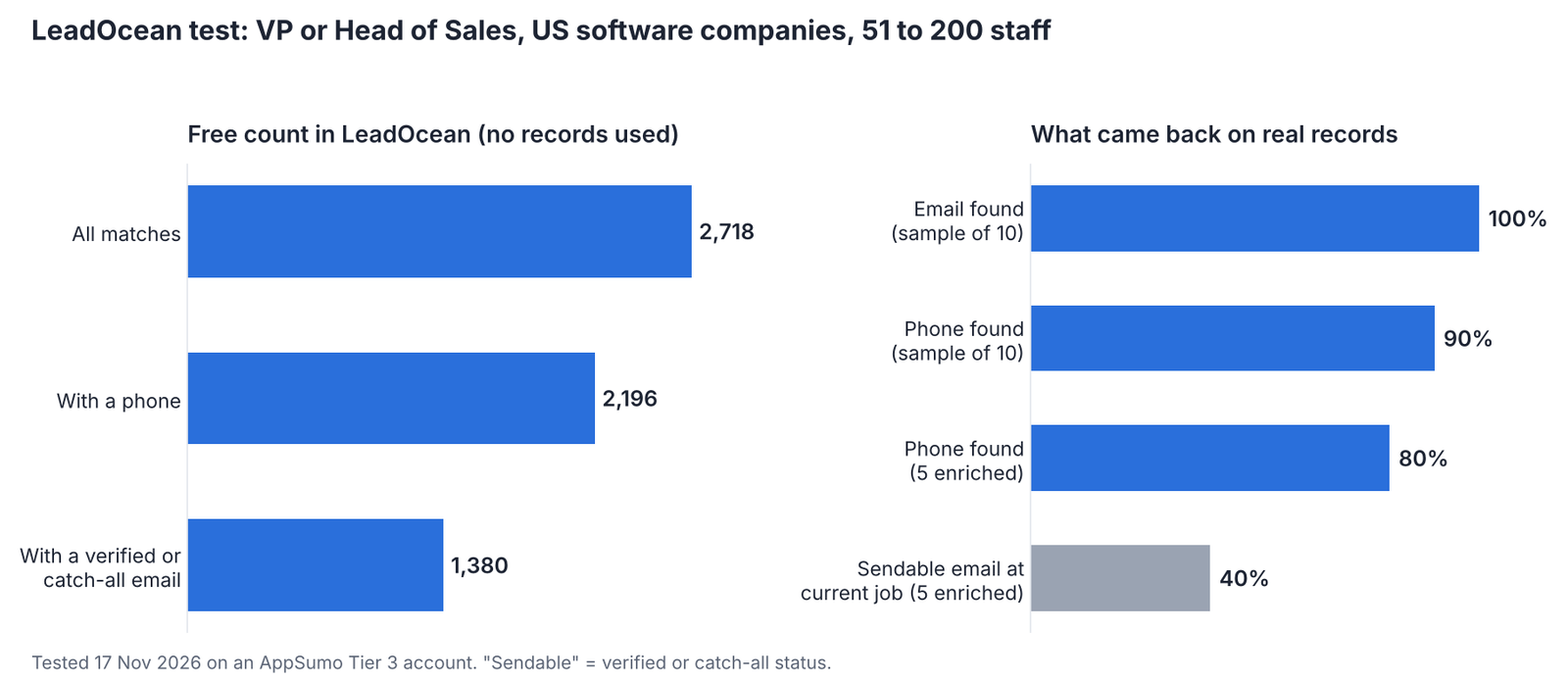
Our LeadOcean test: free counts on the left, results on real records on the right. Tested 17 Nov 2026.
3. Enrich a CRM or spreadsheet you already have
Most teams already have contacts with gaps: no phone, an old title, a missing email.
- LeadOcean: send one identifier (a LinkedIn URL, an email or a phone number) and get the full profile back. A person with no match costs nothing.
- Apollo: CSV, CRM and API enrichment on Basic and above. On the Free plan, CRM enrichment is capped at 100 records a month.
- Lusha: bulk enrichment from the Starter plan, CSV enrichment from Pro.
- ZoomInfo: CRM integrations on its Professional plan.
For a large CRM clean-up, LeadOcean’s flat pricing is the clear win. With credits, every row you enrich has a price; with LeadOcean, it only uses up part of a pace that refills.
4. Get work emails you can safely send to
A cheap email is worthless if it bounces and damages your domain.
- LeadOcean: every email carries one of 13 statuses. “Verified” means LeadOcean checked it, and supplier-only addresses are honestly labelled “untested”.
- Lusha: lists verified emails and phones on every plan. Each email reveal costs 1 credit.
- Apollo: its pricing FAQ says its plans include unlimited email addresses for contacts.
- ZoomInfo: doesn’t publish its pricing, so ask its sales team how emails are counted on your contract.
We didn’t run a bulk bounce test, so we won’t quote a bounce rate. We did check the statuses on real records. In a sample of 10 sales leaders, all 10 had an email on file, and the best address was verified for 1, catch-all for 4, untested for 4 and invalid for 1. Of the 5 people we looked up in full, only 2 had a ready-to-send work email at their current company. So filter by email status, and run untested addresses through a verifier before you send.
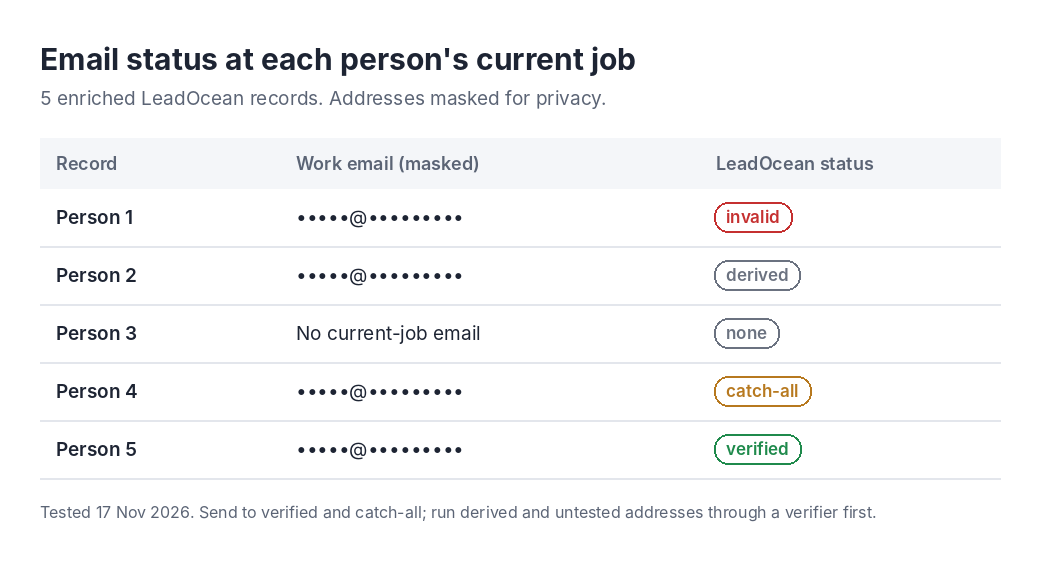
Email status at each person’s current job, from our 17 Nov 2026 test. Addresses are masked.
5. Get phone numbers for cold calls
Phone numbers are where credit pricing hurts most.
- LeadOcean: phones are included on every plan with no per-reveal charge, as mobile, direct and office numbers. AppSumo tiers include 100 to 15,000 phone reveals a month.
- Lusha: each phone reveal costs 5 credits.
- Apollo: phone numbers use credits. Its Basic plan includes a dialer, and calls use credits too.
- ZoomInfo: its Professional plan includes a dialer.
To be fair to the competition, LeadOcean’s own comparison page concedes that ZoomInfo is stronger on direct dials. If your team lives on the phone with enterprise buyers, test both before you decide.
In our test, 9 of 10 sampled people had a phone number on file, and 4 of the 5 people we looked up in full came back with at least one number, several of them labelled mobile.
6. Export 10,000+ leads at once
Big exports are where agencies feel the difference most.
- LeadOcean: up to 50,000 rows per file and 500,000 a day on monthly plans. AppSumo tiers allow 5,000 to 150,000 rows a day.
- Apollo: up to 10,000 leads in one click, with higher limits on higher tiers.
- Lusha: a CSV export costs 1 credit for every 1 to 25 results.
- ZoomInfo: each export uses credits.
On the AppSumo deal, Tier 3 alone allows 25,000 rows a day. That is two and a half Apollo-sized exports every day, at no extra cost.
7. Prospect inside Claude or ChatGPT (MCP)
MCP lets an AI assistant use a data tool directly, so you can ask for leads in plain English.
- LeadOcean: a hosted MCP server on every plan and every AppSumo tier. You sign in with your LeadOcean account, with no API key to paste. It works with Claude, ChatGPT, Cursor, VS Code, Windsurf, n8n and more.
- Apollo: lists an Apollo MCP product. Check which plans include it.
- Lusha: lists MCP in its plan table. Check which plans include it.
- ZoomInfo: check with its sales team.
With LeadOcean, one prompt such as “Find 50 heads of growth at Series A fintech companies in the UK and export them” returns a list and a file, and it uses the same limits as the app.
We ran this whole comparison this way. We asked Claude in plain English, and it used LeadOcean’s MCP tools to size the market, pull a sample and look people up, with no API key and no code. The same kind of request to Apollo’s MCP server on its Free plan came back with “plan does not include”.
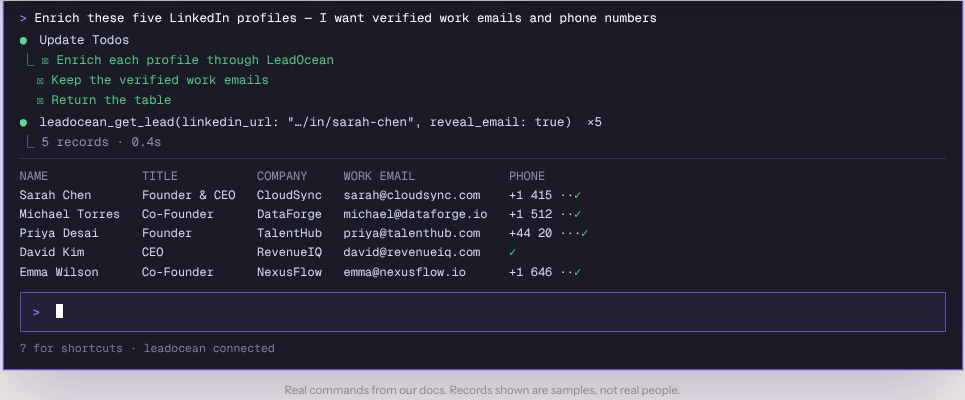
LeadOcean’s MCP tools working inside Claude Code. The records are samples, not real people. Source: leadocean.io, 17 Nov 2026.
8. Plug data into Clay, n8n, Make or Zapier
If you automate your prospecting, the API and its pricing matter more than the app.
- LeadOcean: a Clay HTTP column, a Zapier webhook step, and recipes for Make and n8n, all with one API key. API access is on every plan, including the AppSumo tiers.
- Apollo: more than 200 integrations. API access and limits vary by plan, so check its pricing page for your tier.
- Lusha: API access from the Pro plan, and webhooks on every plan.
- ZoomInfo: ask its sales team what API access your contract includes.
The Clay setup is the one to note. Put LeadOcean first in your enrichment waterfall, and you only pay Clay’s other providers for the rows LeadOcean couldn’t fill.
9. Use the data for client work (agencies)
This is the question many agencies forget to ask, and it can make or break a tool.
- LeadOcean: the monthly Agency plan says you can use it “for your own and your clients’ work”. For the AppSumo tiers, check the licence terms on the deal page or ask LeadOcean before you buy.
- Apollo: its standard plans are for internal business use only. Sharing data with customers or reselling it needs a separate agreement.
- ZoomInfo and Lusha: read their terms, or ask their sales teams, before you use their data for clients.
10. Send the outreach (where LeadOcean stops)
This is LeadOcean’s deliberate gap. It finds and enriches leads; it doesn’t contact them.
- LeadOcean: no sequences and no dialer, by design.
- Apollo: sequences (2 on the Free plan, unlimited on Basic), a deliverability suite and a dialer.
- Lusha: automated email sequences.
- ZoomInfo: a dialer on its Professional plan.
If you go with LeadOcean, plan your stack: LeadOcean for data, plus ReachHQ, Instantly or Smartlead for sending, plus your CRM.
11. Intent data and website visitors
Intent data shows which companies are researching topics like yours right now.
- LeadOcean: none.
- Apollo: intent topics (1 on Free, 6 on Basic) and website visitor identification.
- ZoomInfo: buyer intent and website visitors on Copilot Advanced.
- Lusha: buying intent topics from the Starter plan.
If intent signals drive your outbound, LeadOcean can’t replace these tools. You could still use it to enrich the accounts your intent tool surfaces.
12. Seats, API keys and team use
How a tool counts users decides what it really costs a team.
- LeadOcean: seats and API keys come with the plan, not per person. The monthly Agency plan includes 5 API keys and 5 seats. On AppSumo, Tiers 1 to 4 include 1 to 5 API keys and no team seats; Tier 5 includes 5 keys and 5 team seats.
- Apollo: priced per seat, all seats must be on the same plan, and the Organization plan needs at least 3 seats.
- Lusha: Pro includes 2 seats and Premium includes 5.
For a solo user, this hardly matters. For a team of five, Apollo’s per-seat pricing multiplies by five, while LeadOcean’s Tier 5 covers all five people for one payment.
LeadOcean vs Apollo vs ZoomInfo vs Lusha: full comparison
LeadOcean | Apollo | ZoomInfo | Lusha | |
|---|---|---|---|---|
Pricing model | Flat price, no credits | Credits per seat per year | Annual contract with credits | Credits |
Free plan | 1,000 records, once | 900 credits per seat per year | Not published | 40 credits a month |
Entry paid price | $97 a month, or $49 once on AppSumo | $49 per seat a month, billed annually | Not published | $37.45 a month, billed yearly |
Phone numbers | Included | Use credits | Included in plans | 5 credits each |
Outreach built in | None | Sequences and dialer | Dialer | Sequences |
Chrome extension | No | Yes | Yes | Yes |
Intent data | No | Yes | Yes | Yes |
MCP for AI tools | Every plan | Listed | Ask sales | Listed |
Lifetime deal | Yes, on AppSumo | No | No | No |
Prices from each company’s own pricing page on 17 Nov 2026.
What it costs over 1 and 3 years
This is where a lifetime deal shines. Subscription prices repeat every year; a lifetime deal doesn’t.
Option | Year 1 | 3 years |
|---|---|---|
LeadOcean AppSumo Tier 1 | $49 | $49 |
LeadOcean AppSumo Tier 2 | $199 | $199 |
LeadOcean AppSumo Tier 3 | $399 | $399 |
LeadOcean Solo (monthly) | $1,164 | $3,492 |
Apollo Basic, 1 seat | $588 | $1,764 |
Apollo Professional, 1 seat | $948 | $2,844 |
Lusha Pro (2 seats) | $629.40 | $1,888.20 |
ZoomInfo | Not published | Not published |
Apollo and Lusha figures use annual billing as shown on 17 Nov 2026. Lusha’s price changes with the number of credits you choose, and ZoomInfo only gives prices through its sales team.
The maths is simple. Over three years, Apollo Basic for one person costs $1,764. LeadOcean’s Tier 3, with 500,000 search records and 50,000 enrichments a week, costs $399 in total. The catch is that Apollo includes sequences and a dialer, so you would add a sending tool to the LeadOcean side.
The risks of a lifetime deal, and how to test it in 60 days
A lifetime deal is only worth it if the company stays in business and the product keeps working for you. Be honest with yourself about three things.
- Company size: LeadOcean is a bootstrapped team of 1 to 10 people. The founder answers questions and reviews on AppSumo himself, which is a good sign, but a small team is still a risk to weigh.
- Fair-use limits: the limits are a pace, not a balance. Work out whether your weekly volume fits your tier before you buy.
- Data quality: LeadOcean doesn’t publish an accuracy figure, so test it on your own market.
The 60-day refund window is your safety net. Use it with a plan:
- Run your real ICP search and note the result count.
- Export 500 leads.
- Verify the emails with your usual verifier and check the bounce rate.
- Call 20 of the phone numbers.
- Try the MCP server inside Claude or ChatGPT.
- Decide before day 60, while you can still get a refund.
FAQs
Is LeadOcean a good Apollo alternative?
Yes, if you mainly need data. LeadOcean matches Apollo for list building and enrichment without credits, and includes phone numbers on every plan. It is not a replacement if you rely on Apollo’s sequences, dialer or Chrome extension.
Is LeadOcean cheaper than ZoomInfo?
Almost certainly, but ZoomInfo doesn’t publish its prices, so a direct comparison isn’t possible. ZoomInfo sells annual contracts through its sales team, while LeadOcean starts at $97 a month or $49 once on AppSumo.
What happens when I hit the lifetime deal limits?
You are never charged extra, and you never have to buy more. Your requests slow down until your 5-hour or weekly window refills. On the Tier 3 account we tested, the account settings confirm it: past your pace, requests slow to one a minute rather than being refused, and there is no monthly record cap.
Can I upgrade my AppSumo tier later?
Yes. AppSumo lets you move up or down between the five tiers.
Does the lifetime deal include future updates?
Yes. The deal terms include “all future plan updates”.
Can agencies use LeadOcean for client lists?
On the monthly Agency plan, yes: it allows use for “your own and your clients’ work”. For the AppSumo tiers, check the licence terms on the deal page or ask LeadOcean before you rely on it for client work.
Does LeadOcean have a Chrome extension?
No. LeadOcean works through its web app, its API and its MCP server for AI tools.
Verdict: which option should you choose?
The right answer depends on who you are.
- Agency or lead-gen freelancer: buy Tier 2 or Tier 3, after checking the deal’s licence terms for client work.
- Solo founder: buy Tier 1 and pair it with a low-cost sending tool.
- AI agent builder: any tier works, because the MCP server and API are included on all of them.
- Team of several people: look at Tier 5, which includes 5 team seats and has no weekly cap.
- Sales team that wants one tool: stay on Apollo.
- Enterprise team that needs intent data and org charts: choose ZoomInfo.
For anyone whose main cost is data credits, the LeadOcean lifetime deal is hard to beat. You get a large database, emails, phone numbers and AI access for a one-time price, with 60 days to test it on your own market.
Our rating for LeadOcean: 8/10. It wins on volume, free market counts, phone numbers and price. It loses points on outreach, where it offers nothing, and on current-job emails, where only 2 of the 5 people we looked up had one ready to send.